

Yamamoto means in Japanese ‘foot of the mountain’. It seems that with each collection he designs Yohji Yamamoto climbs from the foot to the summit of a mountain
Yamamoto is one of the most common Japanese surnames, and means ‘foot of the mountain’. It seems that with each collection he designs Yohji Yamamoto climbs from the foot of the mountain to its summit, lingers there for a moment, and immediately returns to the starting point. He has been doing this six times a year for about four decades, each time in a different way. Constant dynamism typifies his work, not only in terms of movement, but also in terms of change. This is not only a way of working, but also a way of life, and a worldview.If we are accustomed to seeing the leader as standing at the apex of the pyramid, leading it from the height of his seat, then Yamamoto sees the whole pyramid which realizes his design visions, as rising above him and held in his hands. He moves, and the pyramid above him takes shape in accordance with his movement; it does not only change position in accordance with his movement, but also changes in accordance with his intentions. Yamamoto is free to move while taking into consideration the constraints hovering above him. He always has to ensure harmony between his changing and what happens above and around him. Loss of harmony would mean collapse of the pyramid, like the collapse he experienced in 2009 when he faced bankruptcy from which he successfully recovered. Designers and fashion houses engage in the harmonious balance of their products with changing fashion trends and the fear of losing the flow and being left behind, which often happens in the fashion world. But Yohji Yamamoto is not a fashion designer; according to him he doesn’t even like fashion. He does not offer his audience fashion products.
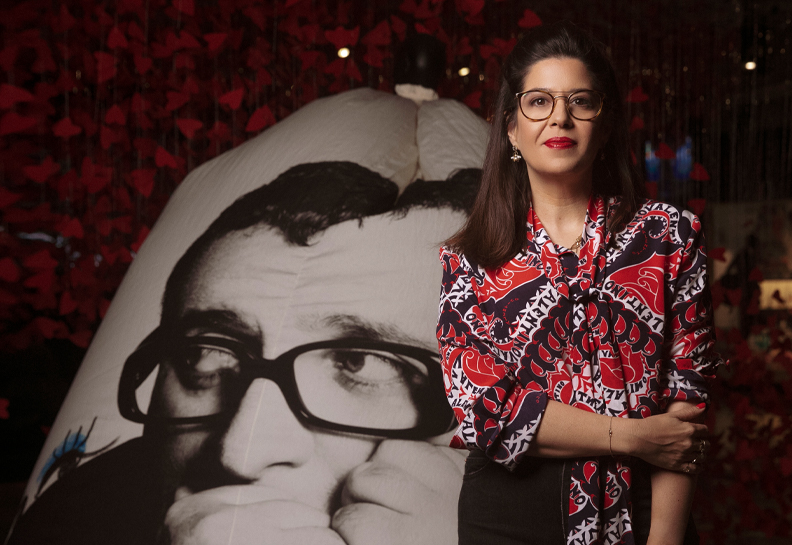
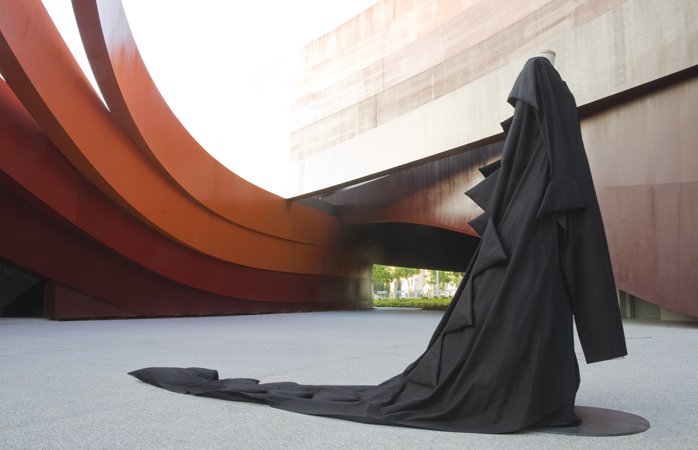 Yohji Yamamoto at Design Museum Holon | Photograph Sharon DerhyYohji Yamamoto considers himself a designer of clothes. Clothes that a person takes with him as fellow travelers on the journey of life. Clothes that are an inseparable part of the person wearing them. Clothes in which the person who regularly wears them can still be recognized even when they are put aside. Like a coat that a person who lives in permanent cold needs, and without which he cannot physically exist. This is how Yamamoto wants a person to feel, that without his clothes he is not himself – not only physically, but mentally as well. Yamamoto does not want the clothes he designs to be fashion items that need to be replaced in order to keep up with current trends. In his view the race after trends amounts to a flat life, life in which clothes are not accorded the meaningful values that time bestows upon them, times of dialogue between garment and owner, of according mutual meaning.Yamamoto’s approach seems to differ from accepted approaches, and an attempt to discover the reason for this difference raises the question of his Japanese origins. Yamamoto says he didn’t know he was a Japanese designer until he came to Paris, which is how he was defined there. He does not consider himself a Japanese designer in terms of someone who represents Japanese design, since the influences on his work, and beyond that on his life, are mainly Western. Punk, for example, greatly influenced him. He sees himself as a designer from Tokyo and from Paris. A designer who develops some six design lines a year, disregards past successes, and looks to the challenges of the moment and new motivations for creativity. It seems that Yamamoto is in a constant state of flux, interacting with surrounding flows, creating gushing rivers rather than pyramids. It is difficult to define him, to put him into a fixed mold; there is something that goes beyond the visual appearance of the clothes he designs. He merges contrasts that in a dualized Western worldview do not go together, and that is perhaps his allure. Showing his work in the Design Museum is an attempt to present and discover what lies beyond appearance.
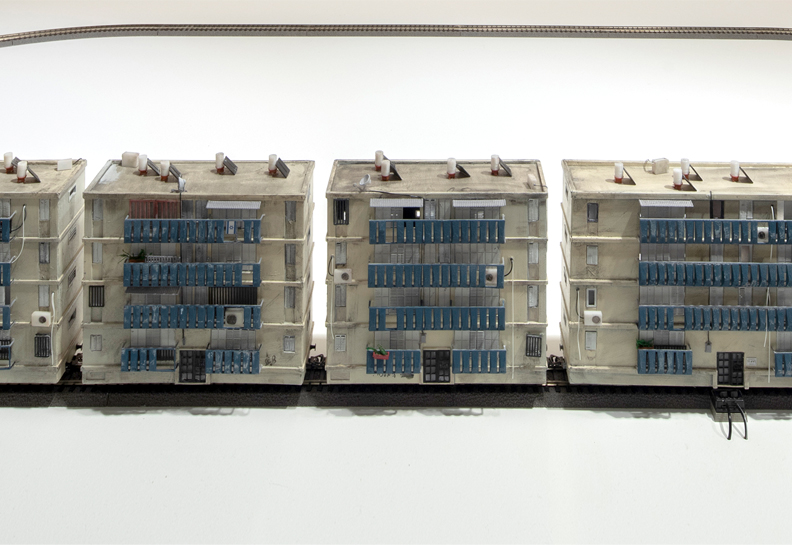
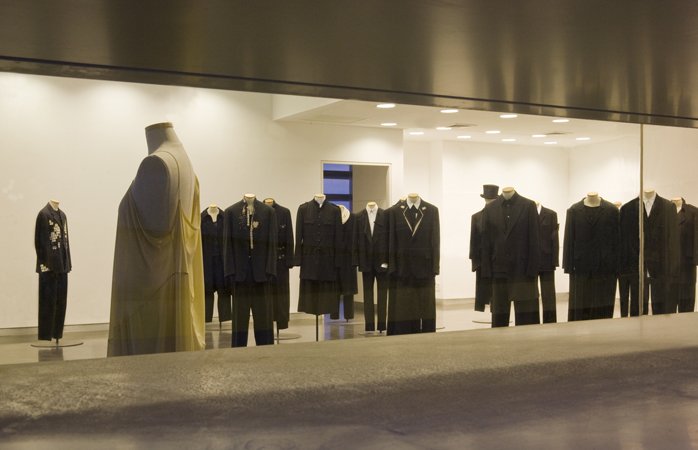 Yohji Yamamoto at Design Museum Holon | Photograph Sharon DerhyYamamoto belongs to a generation of Japanese who turned to the West to learn its ways and live according to them. At the same time, there is no doubt that the Japanese environment in which he grew up left its mark on him by the very fact that he lived in it. Examination of the fashion scene in Japan reveals astounding visual diversity. Japanese street fashion is typified by a variety of different trends, such as Visual Kei, a visual style that is influenced by musicians, Japanese Hip-Hop which, as indicated by its name is influenced by the hip-hop scene, Dolly Kei, a style influenced by European fairy tales and the Brothers Grimm, Lolita, which has nothing to do with the Western Lolita, but rather with a Victorian and Baroque doll-like style, and has sub-styles including Gothic Lolita, Sweet Lolita, Punk Lolita, and several others. Kawaii, which means ‘lovable’, ‘cute’, or ‘adorable’, is a cute design trend that is sweeping Japanese fashion. From the visual aspect it is clear that there is no connection between these various trends and Yamamoto’s work. From the dimension of appearance he cannot serve as a representative model for Japanese design, and it would also seem that Japanese design as a whole is typified by a visual diversity that distances it from any definition in terms of appearance. What characterizes the various Japanese fashions lies beyond appearance; it is the characteristic of the wearer’s personal investment in designing his own outfits. The wearer is an active creator and not only a consumer of ready-to-wear fashion, he is appreciated by his community for the overall appearance he has created from the items he has purchased, made himself, and combined. The investment in appearance creates involvement that goes beyond it; identification is created between garment and wearer. This creative identification is the connecting thread between the various Japanese fashions and Yamamoto’s work; he offers the wearer the means to be designed along with them. Yamamoto the designer proposes that the person designs his own self-design.Yamamoto embarks on the design journey from the material and its contact with the body, but does not waste it on appearance alone. In Japanese mottainai refers to waste, however it refers to far more than just physical waste. It can refer to wasted and wasteful efforts and actions, activities, time, talents, emotion, minds, dreams, and potential, and that is where Yamamoto aims when he designs. Beyond the material and appearance, he aims at emotions, dreams, and the potential to be someone, and from there comes the distinctiveness evident in his work as well.
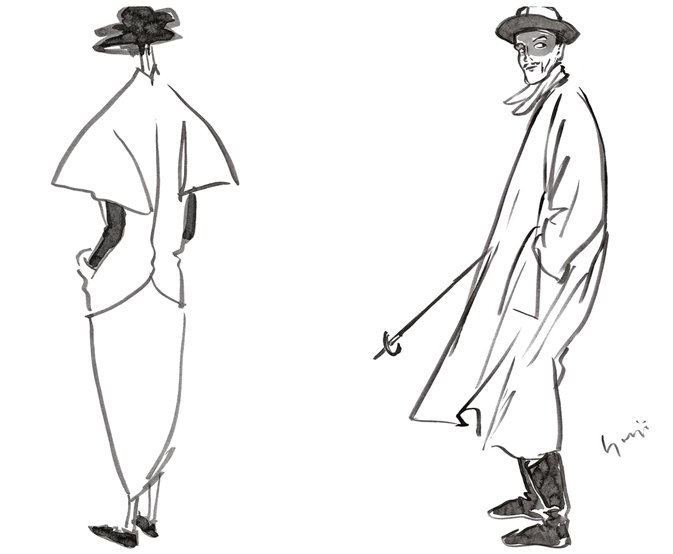
Fashion sketches by Yohji YamamotoEvident beyond visual appearance is the pathos and empathy for ephemera. Mono no aware is a Japanese concept that expresses the impermanence of things and the sense of wistfulness at their passing. Even when the eyes are turned to the West, Japanese culture still remains in the heart. A culture that was closed to the outside world for about two hundred and fifty years during which it consolidated and became established without the possibility of foreign influences permeating it. Zen Buddhist culture and its expression in wabi-sabi still flavor the cherry blossom, the tea ceremony, Japanese raku ware, flower arranging, as the world and outlook of Japanese designers.
Wabi-SabiWhen asked about different concepts in Japanese culture, the Japanese have difficulty providing clear definitions, unlike Western culture that catalogues all knowledge. In Japanese things never have just one meaning, so it is difficult to describe them in Western language that is based on a different worldview. If Western culture sees the world as composed of objects, then Zen-Buddhist Japanese culture sees the world as a flow, as interactions between processes. Interactions composed of interactions, a dynamic picture that is difficult for our Western consciousness, which is accustomed to perceiving absolute objects, to comprehend. This kind of worldview was proposed in the West by the pre-Socratic philosopher Heraclitus who claimed Panta rhei, everything flows, but his proposal was forgotten, and has only gained renewed interest in contemporary times due to chaos and complexity theories.
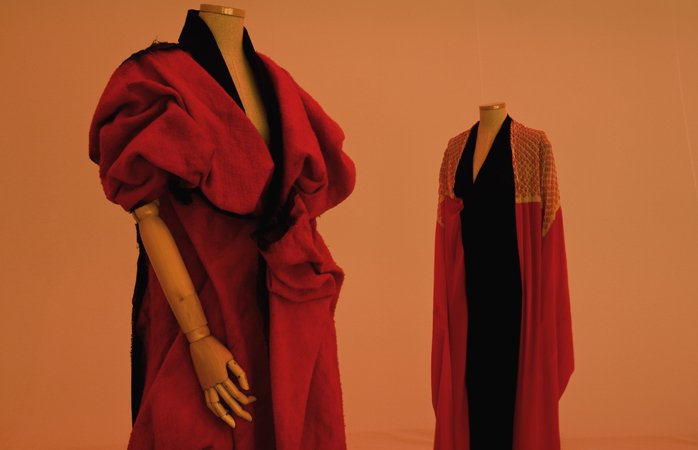 Yohji Yamamoto at Design Museum Holon | Photograph Sharon DerhyIf we inquire into the concept of wabi-sabi we will of course not find a clear definition; the Japanese themselves do not learn wabi-sabi by means of the intellect, but through the logic of the heart. We have to be satisfied with a sense of understanding that comes from examples and experiences, rather than theoretical study. If we view Zen as a theory (a Western concept), then wabi-sabi is its practice, although in actual fact we should view them as united and inseparable. Theory and practice are one, interwoven into a person’s every action, thought, and behavior. The state of dualistic contrast with which we are familiar – theory-practice, body-soul, inner-outer, up-down – do not exist when one sees the world as emerging from processes rather than being constructed of elements, from universal experiences. The Middle Way, the Buddhist way, does not see a thing as existing, but as being in existence. There is no given world, just as there is no absolute I, everything is in a state of constant becoming.If we are in a state of constantly becoming, being born, growing old, withering, and dying in order to reappear in the world in a different form, thus too in what we do. The design that we design is not a fixed appearance, frozen like a picture, an object; design is systems of influencing and changing interactions. The Buddhist does not seek absolute, perfect, permanent beauty, for it does not exist in his world, but rather impermanent and changing perfection. The experience of observing something is never reduced to an examination of proportions, composition, colorfulness or form as independent elements that constitute an esthetic experience; the experience also includes the meaning of the marks of time and use of the thing, the way in which we behave with it, our relationship with others of its kind, and its relationship with the context in which it exists… The whole is a spiritual experience just as much as it is a sensory one.
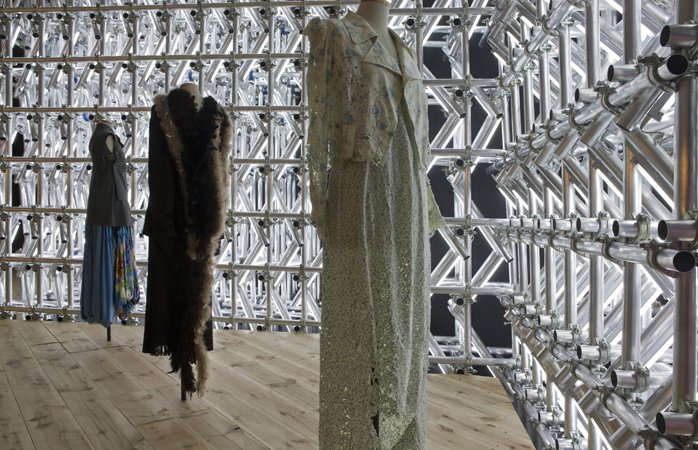 Yohji Yamamoto at Design Museum Holon | Photograph Sharon DerhyTherefore, when Yamamoto says that he designs clothes, this does not mean the reductive cutting and giving form to materials, but the design of fellow travelers on the journeys of life. We should not be satisfied with the question of whether they are beautiful in our eyes, but also whether they are good for our heart, and whether we feel that we can formulate some kind of truth with them. Wabi-sabi is the moment at which the garment’s soul is created.Some might say that wabi-sabi is the beauty in imperfect, impermanent, unfinished things, and they would be right, but what should immediately be added is that according to this worldview everything is partial, impermanent, and flawed, for that is the nature of our world. Even if something seems perfect at this moment, beyond its appearance in this moment it is in a process of changing, and designers have to attend to its changing design.Misunderstanding wabi-sabi is inherent. The basic Western premise that there is absolute understanding and that everything can be defined is inapplicable to understanding wabi-sabi. When this feeling of elusiveness arises, of vanishing appearance, of one hand clapping, the cosmos is breached and the understanding comes that there is no understanding. Japanese design, Yohji Yamamoto’s design, and perhaps design in general, should not and cannot be defined and understood absolutely, and considerable room should be given to emotions to present the opinion of what lies beyond appearance.
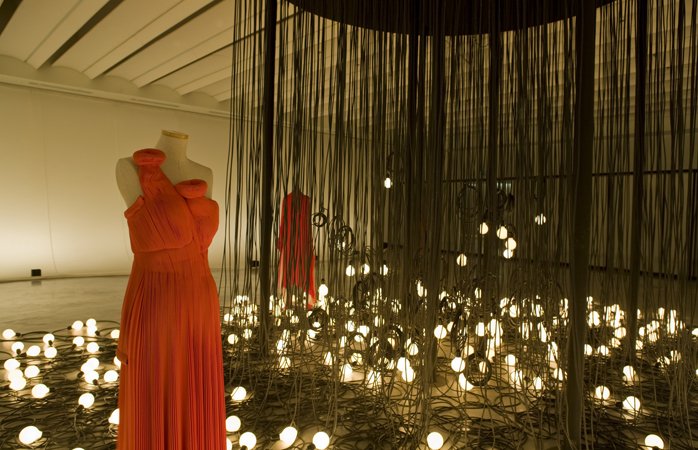 Yohji Yamamoto at Design Museum Holon | Photograph Sharon Derhy